What is a Streaming Edge Server? (The Simple Explanation)
Imagine you're running a popular online radio station from your studio in Chicago. Your music is great, your content is engaging, and your audience is growing. But you start getting emails: listeners in London complain about buffering, fans in Tokyo say the stream keeps dropping, and even some folks in Los Angeles are experiencing lag. What's going on? Your internet is fast, and your computer is powerful.
The problem isn't your broadcast; it's the distance. Sending a live audio stream across continents to hundreds or thousands of individual listeners from a single point is incredibly inefficient. The further the data has to travel, the more "hops" it takes through various internet networks, increasing the chance of delays (latency) and dropped data packets (buffering).
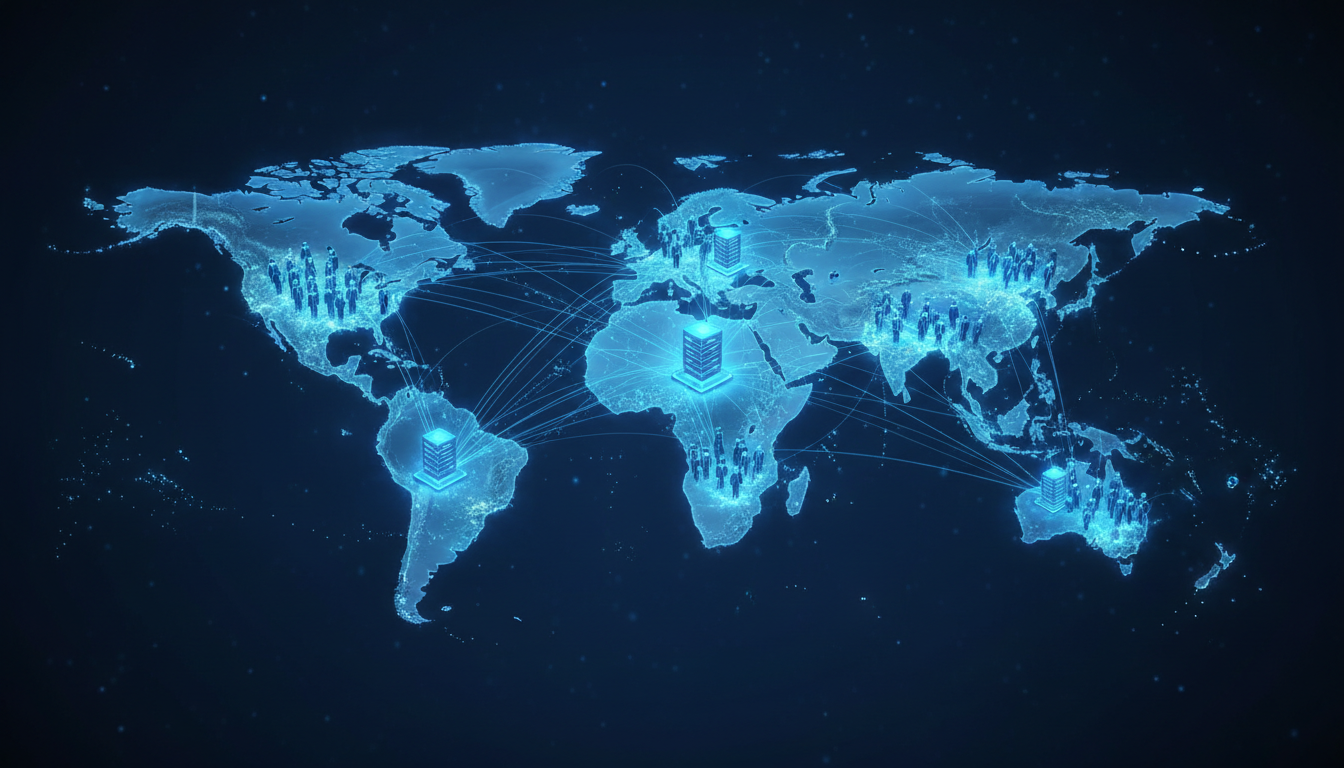
This is where a streaming edge server comes in. Think of it like a global network of convenience stores for your stream. Instead of forcing every listener to travel to one giant supermarket (your single server in Chicago), you place smaller, fully-stocked stores (edge servers) in neighborhoods all over the world.
An edge server is a powerful computer that is part of a larger network called a Content Delivery Network (CDN). Its primary job is to sit at the "edge" of the internet, geographically close to your listeners. It takes a copy of your main broadcast and serves it directly to listeners in its local region. So, your listener in London connects to an edge server in London, not your server in Chicago. The result? A faster, more reliable, buffer-free listening experience.
Pro Tip: Think Local Delivery
A CDN with edge servers is the difference between mailing thousands of individual letters from your house (slow, expensive, unreliable) and sending one single package to a global postal service that handles all the local deliveries for you. You do the creative work; the edge network handles the massive distribution.
How Do Edge Servers Work for Audio Streaming?
The process is complex behind the scenes, but from a broadcaster's perspective, it's beautifully simple. At Shoutcast Net, we've built our entire platform around this powerful technology to make global broadcasting easy and affordable. Here’s a step-by-step breakdown of the data flow:
    [You, the Broadcaster] ----> (1. Single Upload) ----> [Shoutcast Net Origin Server]
                                                                |
                                                                |
                                             (2. Instant Replication to CDN)
                                                                |
                                                                V
                        +-----------------------+-----------------------+-----------------------+
                        |                       |                       |                       |
                [Edge Server: London]   [Edge Server: Sydney]   [Edge Server: New York]   [...and 50+ more]
                        |                       |                       |
                        |                       |                       |
            (3. Local Delivery)     (3. Local Delivery)     (3. Local Delivery)
                        |                       |                       |
                        V                       V                       V
                [Listeners in UK]     [Listeners in AU/NZ]    [Listeners in US East]
- The Ingest (Your Upload): You configure your broadcasting software (like BUTT, OBS, RadioBOSS, or hardware encoders) to send one single, high-quality stream to the unique server address and port we provide. This is called the "origin" or "ingest" server. You only need enough upload speed for this one stream, not for hundreds of listeners.
- The Distribution (Our CDN): The moment your stream hits our origin server, our system instantly replicates and pushes it out across our global CDN to dozens of edge servers strategically located in data centers around the world. This happens automatically in milliseconds.
- The Connection (Listener's Request): When a listener clicks "play" on your stream player, our system automatically detects their geographic location. It then directs their player to connect to the closest, lowest-latency edge server available to them.
- The Delivery (Local Streaming): The edge server, which already has a perfect copy of your stream, begins delivering it directly to the listener. The data travels a much shorter physical distance, dramatically reducing buffering and providing a crisp, clean connection. This architecture allows us to achieve a very low latency 3 sec broadcast delay for time-sensitive events.
Pro Tip: Universal Compatibility
Our advanced origin-edge infrastructure allows us to translate between protocols. This means you can stream from any device to any device using our service. We handle all the conversions, supporting everything from legacy to modern formats. We can process any stream protocols to any stream protocols (RTMP, RTSP, WebRTC, SRT, etc), ensuring your broadcast reaches the widest possible audience on any player.
The 'Last Mile' Problem: Why Your Home Internet Isn't Enough
Many new broadcasters believe that if they have a "1 Gigabit" fiber internet connection, they can host their own stream. This is a common and costly misconception that stems from a misunderstanding of how residential internet works and the "Last Mile Problem."
The "last mile" refers to the final leg of the network that connects a service provider's network to the end-user—you at your studio, or the listener at their home. This connection is almost always asymmetrical, meaning your download speed is vastly higher than your upload speed.
The Math of Self-Hosting
Let's do some simple math. A standard, good-quality audio stream is 128kbps (kilobits per second). To serve this stream to 100 simultaneous listeners, you would need:
128 kbps * 100 listeners = 12,800 kbps = 12.8 Mbps (Megabits per second)
While many home connections have 20-30 Mbps of *upload* speed on paper, this bandwidth is shared with every other device in your home and is often not sustained. Running your upload speed at 80-100% capacity for hours will cause packet loss, connection instability, and make your stream buffer for everyone. If you want 1,000 listeners? You'd need a dedicated 128+ Mbps of stable upload bandwidth—something far beyond residential or even small business internet plans.
Using a CDN like Shoutcast Net's solves this. You only need a stable ~128kbps of upload to send your stream to us. We take that one stream and use our multi-gigabit data center connections to serve the 10, 100, or 10,000 listeners. You're offloading the heavy lifting to our professional infrastructure.
Pro Tip: Focus on Your Show, Not Your ISP
Don't let your broadcast quality be dictated by the limitations of your home internet provider. By sending just one stream to our origin server, you insulate your station from local network congestion, outages, or upload speed limitations. It's the most reliable way to ensure a professional sound for your audience, no matter how large it gets.
Edge Servers vs. Origin Servers: What's the Difference?
While they work together, origin and edge servers have very different roles in a streaming architecture. Understanding the distinction highlights the power of the CDN model.
| Feature | Origin Server | Edge Server |
|---|---|---|
| Primary Role | The single source of truth. Ingests your live broadcast and manages content like AutoDJ playlists. | Massive, parallel delivery. Serves the stream to a high volume of listeners in a specific geographic area. |
| Location | Typically a single, centralized, powerful server. | A large network of servers distributed globally, close to population centers. |
| Connections | Handles one incoming connection (from you, the broadcaster) and connections to the edge servers. | Handles thousands of simultaneous outgoing connections (to your listeners). |
| Functionality | Processing, transcoding, recording, playlist management. This is where your AutoDJ runs. | Caching (storing a temporary copy of the stream) and high-volume delivery. Purely focused on performance. |
| Analogy | The master recording studio. | The global network of radio towers broadcasting the signal. |
With a Shoutcast Net plan, you get the best of both worlds. You interact with a simple, powerful origin server interface to manage your station and AutoDJ, while our massive, invisible edge network ensures your stream is delivered flawlessly to every listener, everywhere.
Pro Tip: The Standalone Server Limitation
A basic Shoutcast or Icecast server from another provider is often just an origin server with no edge network. This is why they can't handle large, geographically diverse audiences. They are essentially asking listeners from all over the world to connect back to one single server, re-creating the "last mile" problem on a global scale.
Benefits of Using a CDN for Your Station
Integrating a CDN with edge servers into your broadcast workflow isn't just a technical upgrade; it's a strategic advantage that directly translates to a more professional station and a larger, more satisfied audience.
- Global Reach & Scalability: Go from 10 to 10,000 listeners without changing a single setting. Our network scales automatically to meet demand. All our plans come with up to 1,000 listeners, so you're never capped.
- Drastically Reduced Latency & Buffering: By serving your stream from a local server, you cut down the physical distance data travels, which is the number one cause of lag. This is how we can offer very low latency 3 sec options for near real-time broadcasts.
- Ironclad Reliability & Uptime: Our CDN provides massive redundancy. If an edge server in one city has an issue, listeners are automatically and seamlessly rerouted to the next-closest server. This is how we guarantee 99.9% uptime for your station.
- DDoS Protection: Individual servers are vulnerable to Distributed Denial of Service (DDoS) attacks. A global CDN has the scale and intelligence to absorb and mitigate these attacks, keeping your station on the air.
- Enhanced Security: All streams on our network can be secured with SSL streaming (HTTPS) for free. This encrypts the connection, protects listener privacy, and prevents "mixed content" warnings in modern web browsers.
- Advanced Features: Our CDN infrastructure enables powerful features like the ability to Restream to Facebook, Twitch, YouTube and other social platforms simultaneously, expanding your reach exponentially.
Pro Tip: Future-Proof Your Station
Starting with a service that includes a CDN from day one is the smartest move you can make. It means you'll never have to worry about outgrowing your hosting plan. As your station becomes more popular, our network will simply absorb the load. You can focus on creating great content, not on emergency server migrations.
Why Shoutcast Net's Flat-Rate CDN Beats Per-Viewer Pricing
The final, and most critical, piece of the puzzle is the business model. The most powerful technology is useless if it's not affordable. This is where Shoutcast Net creates a clear and compelling advantage for broadcasters of all sizes.
The Competition's Pricing Traps
Many other streaming providers, especially those built on platforms like Wowza, use pricing models that punish success:
- Per-Viewer or Per-Slot Pricing: You buy a plan for "50 slots". If you get 51 listeners, the 51st is rejected. To grow, you have to constantly upgrade.
- Bandwidth/Data Transfer Pricing: You pay for the amount of data your listeners consume. If you have a great show and listeners tune in for hours, you get hit with a massive, unpredictable bill at the end of the month. This model makes success a financial liability.
- Legacy Server Limitations: Providers offering cheap, standalone Shoutcast servers without a CDN are selling you an incomplete solution. Your stream will inevitably fail as your audience grows or becomes more geographically diverse.
These models force you to choose between limiting your audience and facing a shocking invoice. It's a fundamentally flawed approach for independent broadcasters.
The Shoutcast Net Advantage: Predictable, Flat-Rate Power
We believe you should be rewarded for your success, not penalized for it. Our entire business model is built around this principle. With plans starting at just $4/month, here's what you get:
- ✓ Up to 1,000 Listeners: We don't care if you have 10 or 1,000 listeners. Your price stays the same.
- ✓ Unmetered Bandwidth: Your listeners can tune in 24/7. We'll never send you an overage bill.
- ✓ Global CDN Included: Every plan, even our smallest, is powered by our global edge network.
- ✓ Powerful AutoDJ System: Keep your station running 24/7, even when you're not broadcasting live.
- ✓ Predictable Billing: The price you sign up for is the price you pay. No surprises.
We provide the robust, scalable infrastructure of an enterprise-level CDN with the simple, affordable, flat-rate pricing that independent broadcasters need. You get all the power without the complexity or the financial risk.
Ready to experience the power of a true streaming CDN? You can get started in minutes. All of our plans come with a no-risk, no-credit-card-required 7 days trial.
Pro Tip: The Smart Investment
Choosing Shoutcast Net isn't just buying a server; it's investing in an infrastructure platform. For a low, flat monthly fee, you get access to a global delivery network that would cost thousands of dollars per month to build yourself. It's the most cost-effective way to guarantee a professional, scalable, and reliable broadcast for your station. Check out our affordable plans today!